Couette viscometer
When a liquid is sheared the lubricant exerts a resisting shear stress  to the motion. The proportion between resistance and certain shear rate
  may be called viscosity
  . By using the definition
(1) 
the viscosity can be derived from measurements. A steady shear experiment with a measurement of the resulting shear force may lead to the possibility to determine the viscosity as shown in Figure 1.
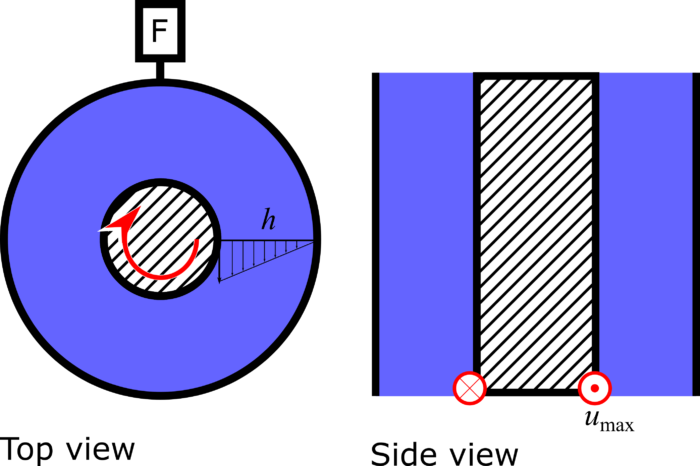
By using a cylinder rotating, at constant speed, in another cylinder a gap filled with liquid of height  is sheared. Assuming the linear shear profile the shear rate then is constant across the gap and we can thus simplify
  with dimension of
  . The shear stress is given by dividing the measured force
  by the surface area
  . It should be noted, that the length must be sufficient to enable a measurement, which is not disturbed by the edge effects.
If the speed is too great or the gap to small, the shear stress in the lubricant may reach values leading to different lubricant beahviour. This is mostly a drop in viscosity driven by thermal effects as well non-Newton’ian effects. These will be adressed in another post.
Falling body viscometer
Other methods to measure the dynamic viscosity are falling body viscometers as depicted in Fgure 2.
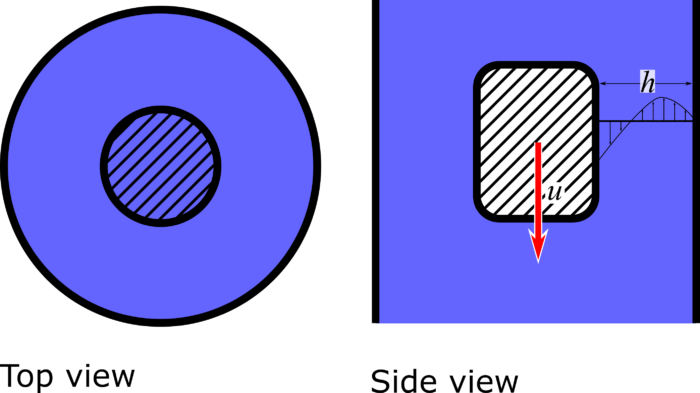
By letting a body drop in a tube with known clearance and measureing the velocity that the falling body reaches in the liquid, it is again possible to determine the shear stress. As a direct determination is not readily achievable, these viscometers are usually calibrated using liquids of known viscosity.
By varying the gap or the sinker weight (material density) different shear stresses may be reached in the viscometer. The form of the sinker can also influence the stability and repeatability of the falling body setup.
Discussion
Using these viscometers usually the viscosity at low shear rates is determined with falling body viscometers. This low shear viscosity  is most commonly used in standard engineering applications. If the shear rate is increased notably using for example Couette viscometers the lubricant viscosity may become shear rate dependent. By forming the ratio of
  it is possible to obtain fluid typical curves, which represent the fluid behaviour. These will be part of the next post.